
Build Horry County 72-Hour Releases
The official Horry County Bookings & Releases application has no distinct 72-hour endpoint or rolling control. It accepts a single Release Date. Most three-day checks therefore require three searches, while a precise interval spanning parts of four dates requires four. Results from the boundary dates must be narrowed by the displayed release time.
The wider span is useful for catching events that a same-day review missed. It does not change what the source proves. A result with a dated “Released” label records an exit from J. Reuben Long Detention Center for that booking. It does not by itself show that all charges ended, a sentence fully discharged, or no other custodian received the person.
Check Horry County Three-Day Releases
Define the 72-hour start and end before searching. A Monday afternoon review may reach back into Friday afternoon, which means a simple Saturday-through-Monday set would omit part of Friday. Conversely, all Friday results should not be counted when the period began late that day. Keeping the visible time with each record prevents that error.
- Write down the start and end of the exact 72-hour period.
- List every calendar date touched, including a partial first or fourth date.
- Search each date separately in the application’s Release Date field.
- Open each detail and record the release date, time, label, and booking number.
- Remove events before the start or after the end of the chosen window.
- Save the “Data last collected” value and verify unclear results with JRLDC.
A last name can reduce a large set, but it changes the task from a full three-day sweep toward a person-specific check. Use the booking number and age or other identity details to separate similar names. The Released Last 24 Hours method is the better fit when only today’s newest events matter.
Note: Record each date searched so another reader can reproduce the same official query and compare later updates.
Horry County 72-Hour Record Fields
The detail view, rather than the search row alone, holds the evidence needed to interpret a release. The booking number anchors the event. The release timestamp defines whether it falls inside the chosen window. Charges, bail, and disposition can add context but do not replace the Horry Public Index or the court that handled a municipal case.
| Field | How to use it |
|---|---|
| Name and demographics | Distinguish records for people with similar names. |
| Booking date and number | Tie the release to one specific jail episode. |
| Release date and time | Test whether the event belongs inside the exact 72-hour span. |
| Status or home-detention indicator | Separate Released, Out to Home Detention, and Still Incarcerated. |
| Arresting agency | Identify the agency connected with the booking. |
| Charges, bail, disposition | Provide limited booking and case context. |
| Booking photograph | Help identify the booking record without proving guilt or current status. |
The county application pictured here exposes a Release Date input and its data-collection marker.
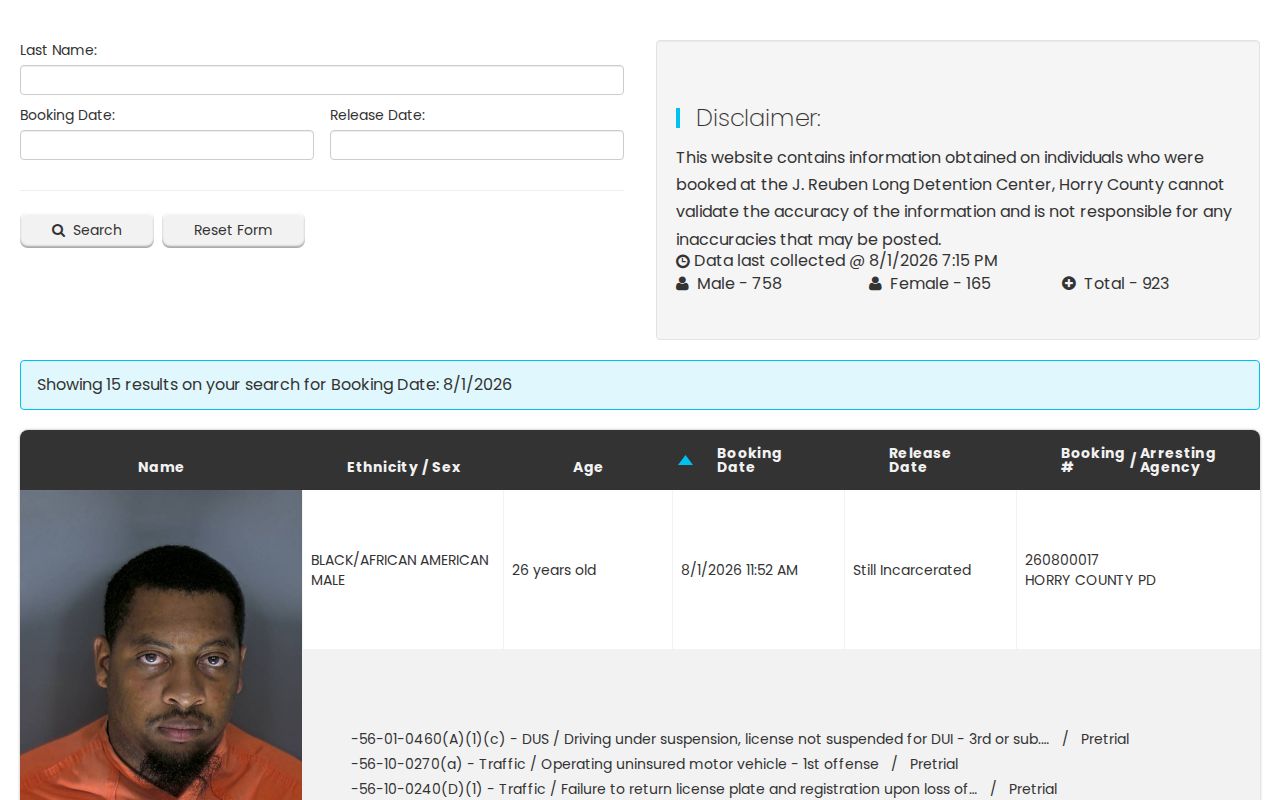
The screenshot supports a date-by-date workflow, not a claim that Horry County publishes a ready-made three-day feed.
Weekend Horry County Release Checks
Weekends and holidays make the broader window practical, but they do not create a special release schedule. The official bond material says the Magistrate Office operates during published weekend and holiday hours, and bond hearings typically occur at set morning and afternoon times. Those facts concern access to the bond process. They do not guarantee when JRLDC will finish release processing.
For a Friday-to-Monday span, run each implicated date and use the timestamps. A bond order may appear in the court record before the physical release is processed. The Horry jail record is the better source for the actual exit event, while the court record explains the legal basis. If the application still says “Still Incarcerated,” check the collection time and contact the detention center.
Holiday staffing, another hold, transport to a receiving agency, or ordinary data delay can change when an event becomes visible. The research found no universal weekend release hour, exit door, waiting area, or holiday processing schedule. Questions about a current person should go to the custodian instead of relying on a calendar assumption.
A clean audit trail is more useful than a broad claim. Keep the first and last timestamps, every date searched, the visible collection marker, and the booking numbers reviewed. If Monday’s search later adds a Sunday event, the two observations can be reconciled as a later data state. Neither observation should be rewritten as a county guarantee about when processing occurred.
Horry County Release Data Limits
The application shows “Data last collected,” but the county does not publish a guaranteed update cadence. That timestamp is useful audit context, not a promise that every recent transaction is already shown. A newly completed release may lag. Write down when the search was made and when data was last collected, then check again or call when the answer is time-sensitive.
No official online-retention period is published either. The ability to retrieve one old record does not establish how long all records remain searchable. Expungement, records schedules, migrations, or interface changes can affect visibility. A custodian may still hold a releasable agency record even after the public application stops returning it.
Note: A visible collection timestamp aids review, but it cannot substitute for a dated release label tied to the booking.
Recover Missing Horry Release Records
For an urgent county status question, contact J. Reuben Long Detention Center at 843-915-5140 or Booking at 843-915-6911. Provide the full name and booking number when known. VINE/SAVIN can report an agency-fed event or provide advance alerts, but it is not the sole historical proof of an old release.
For a missing or older event, send a focused request through the Horry County FOIA channel. Include the full name, approximate booking and release dates, and booking number. Request the final release date and time, release disposition or type, releasing facility, and only the related records actually needed. Ask for an electronic response and a cost estimate.
The Horry Public Index supplies legal context such as a bond order, sentence, dismissal, or other disposition. It proves physical release only if the filed record expressly says so. A city matter may require the specific municipal court. Together, the detention record and the court file answer different parts of the event.
VINE/SAVIN is another useful path when notice was registered before the event. It can show that the feeding agency reported a custody change, though a transfer and a release need different wording. For lasting proof, return to the release record created by the custodian. For present supervision after a state release, use SCDPPPS rather than trying to stretch the jail application beyond its scope.
Separate Horry Release Custody Paths
A JRLDC release and an SCDC release belong to different record systems. If Horry County transferred the person to state prison, use the current SCDC inmate search after intake. That transfer is not community release. If the person later left an SCDC institution, use the SCDC Released Inmate List and read its Release Type literally.
| Record state | Correct source | Meaning |
|---|---|---|
| Released from JRLDC | Horry Bookings & Releases | Exit from the county booking event |
| Out to Home Detention | Horry record and responsible county office | Exit from secure jail with control continuing |
| Transferred to SCDC | Current SCDC search | Custody moved to the state prison system |
| Released from SCDC | SCDC Released Inmate List | Institutional exit with the listed release type |
| Community supervision | SCDPPPS offender search | A supervised phase that may follow institutional release |
Federal and immigration transitions sit outside those state and county tools. BOP, USMS, ICE, a receiving facility, or the relevant court may be needed. For one person across all of these channels, use the Horry County release record search path.
Read Horry County Release Results
A precise statement stays within the source: “Horry County recorded this person as released on” the shown date and time. Do not convert a bond release into a final case outcome. Do not describe home detention as unconditional discharge. Do not treat a transfer as entry into the community. A person can also be released and later booked again, which makes the booking number and event date essential.
The best evidence names the person, the custodian, the event type, and the date or time. When two sources conflict, assign each fact to the office that owns it: JRLDC for its physical release, the court for its order or disposition, SCDC for state institutional custody, and SCDPPPS for supervision. Newer records may supersede older ones without making either record false at its own timestamp.