
Horry Scheduled and Actual Release
A projected date is a working sentence-administration estimate. It is not the same as the date and time that a person physically leaves custody. For a sentenced person, staff apply the judgment, jail credit, sentence structure, and credits allowed by law. Those inputs can change. For a pretrial detainee, release instead turns on bond, a court order, dismissal, a hold, or later sentencing, so there may be no computed sentence-release date at all.
An actual county release appears as a dated event in Horry County's Bookings & Releases system. An actual state-prison exit appears in the SCDC Released Inmate List. “Out to Home Detention” remains a form of custody, and transfer to another agency is not release to the community. A parole grant can authorize a future transition but is not the exit event itself.
A court order and a custody record can also carry different times without being inconsistent. The order supplies legal authority. Jail staff may still need to verify identity, receive bond, check other holds, and finish administrative processing. Use “the court authorized release” for the order and “JRLDC recorded release” for the physical event. That wording keeps the two facts in their proper scope.
- Projected date
- An estimate based on sentence and credit rules that can still change.
- Actual release
- The recorded event when a named custodian ends its physical custody.
- Detainer
- A request or hold from another authority that may change where the person goes.
- Concurrent sentences
- Terms served at the same time, as authorized by the judgments.
- Consecutive sentences
- Terms served one after another and aggregated for calculation.
Find a Horry Inmate Release Date
First identify who has custody. The J. Reuben Long Detention Center calculates qualifying short local terms under its published method. SCDC administers state-prison sentences. A court controls its orders but does not perform every physical release step. Using the wrong system can produce a correct record about the wrong phase.
- Confirm the custodian. Use Horry County Bookings & Releases for JRLDC, or the SCDC current search for a person sentenced to and held by SCDC.
- For a JRLDC sentence, call the detention center at 843-915-5140 about the current local calculation. Compare the result with the sentencing order.
- For an SCDC sentence, use the official Release Date Calculation only as a general estimate, then contact SCDC Inmate Records at 803-896-8531 for a named person.
- Check for later judgments, consecutive terms, forfeited credits, or detainers that may alter the estimate or destination.
- After the date passes, confirm the event in the Horry record or the SCDC Released Inmate List. A future estimate is never proof of release.
For a county event, the full Horry County release search path combines the dated jail result with court context. A person transferred from JRLDC to SCDC is still in custody and should be checked in the state current-inmate search after intake.
When the record belongs to a federal sentence or immigration case, neither local classification nor the SCDC calculator applies. The BOP locator can show a projected or actual federal release field for sentenced federal custody. ICE's locator has a limited current and recent-release scope. A Horry County jail departure under a federal or immigration hold may be a transfer, so the receiving authority must confirm the next phase.
Horry Jail Release-Time Calculation
JRLDC publishes unusually specific local rules. Its classification department calculates criminal sentences of 90 days or less and Family Court commitments of any length. The detention center says “Time” updates daily after 2 p.m. That update point explains why a recently changed credit or judgment may not appear in the same way throughout the day. It does not promise a universal release hour.
The county states that local good time is one day's reduction for every two days served after sentencing when institutional rules are faithfully observed. Work credit can provide two days' reduction for every one day worked after the person has been sentenced on all charges, medically cleared, and given a qualifying work assignment. A judge may deny work credit. These local rules should not be mixed with SCDC's state-prison credits or its projection tool.
The official JRLDC local sentence and release page shows the county calculation details.
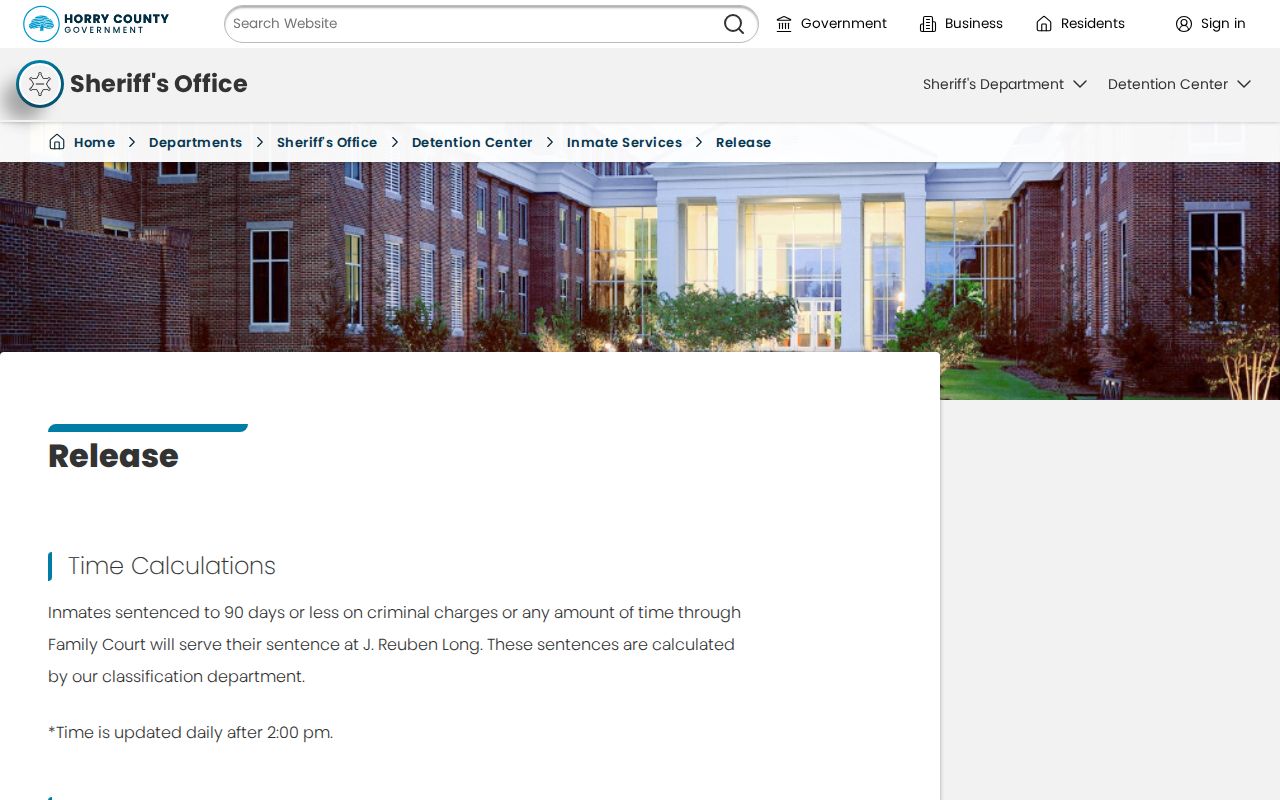
The county page also states that released people arrange transportation, a separate practical issue that does not alter the legal calculation.
| Horry local factor | Published effect | Limit |
|---|---|---|
| Good time | One day deducted for every two days served after sentencing | Depends on following institutional rules and may be forfeited |
| Work credit | Two days reduced for each day worked | Requires all-charge sentencing, medical clearance, qualifying work assignment, and no judicial denial |
| Daily update | “Time” updates after 2 p.m. | Not a promised daily release time |
| Pretrial status | No local sentence calculation | Release depends on bond, court action, holds, or sentencing |
Horry State-Prison Release Projection
South Carolina's sentence-credit rules differ by offense class and sentence. Section 24-13-100 defines a “no parole offense” to include a Class A, B, or C felony and listed exempt offenses with a maximum penalty of at least 20 years. Under South Carolina Code Section 24-13-150, a person sentenced to SCDC for such an offense must serve at least 85 percent of the actual unsuspended term before early release, discharge, or statutory community supervision. Credits cannot reduce time below that floor.
Section 24-13-210 permits a non-no-parole SCDC prisoner to earn 20 days per month of good conduct. A no-parole offender may earn three days per month, subject to exclusions and the 85-percent minimum. Credits can be forfeited. Section 24-13-230 permits work or education reductions within different limits: generally zero to one day for every two qualifying days for a non-no-parole term, capped annually, while a no-parole offense has a smaller monthly and annual amount and still cannot cross its floor.
A sound estimate begins with the actual unsuspended sentence. It then applies lawful jail credit, distinguishes concurrent from consecutive judgments, adds only credits that the person can earn, and respects every statutory minimum. South Carolina uses a 365-day year under Section 24-13-175. Later sentences, unearned or lost credits, and detainers require a new calculation.
Do not multiply a credit rate without first deciding which statutory class applies. The no-parole definition, offense date, actual unsuspended term, and any mandatory minimum can control the floor. Educational credits have participation and offense limits. Consecutive sentences aggregate. A simple arithmetic result that ignores those limits may look precise while being legally wrong.
SCDC labels its public calculator an “earliest possible case scenario.” The official calculator disclaimer can be seen in the captured state page.
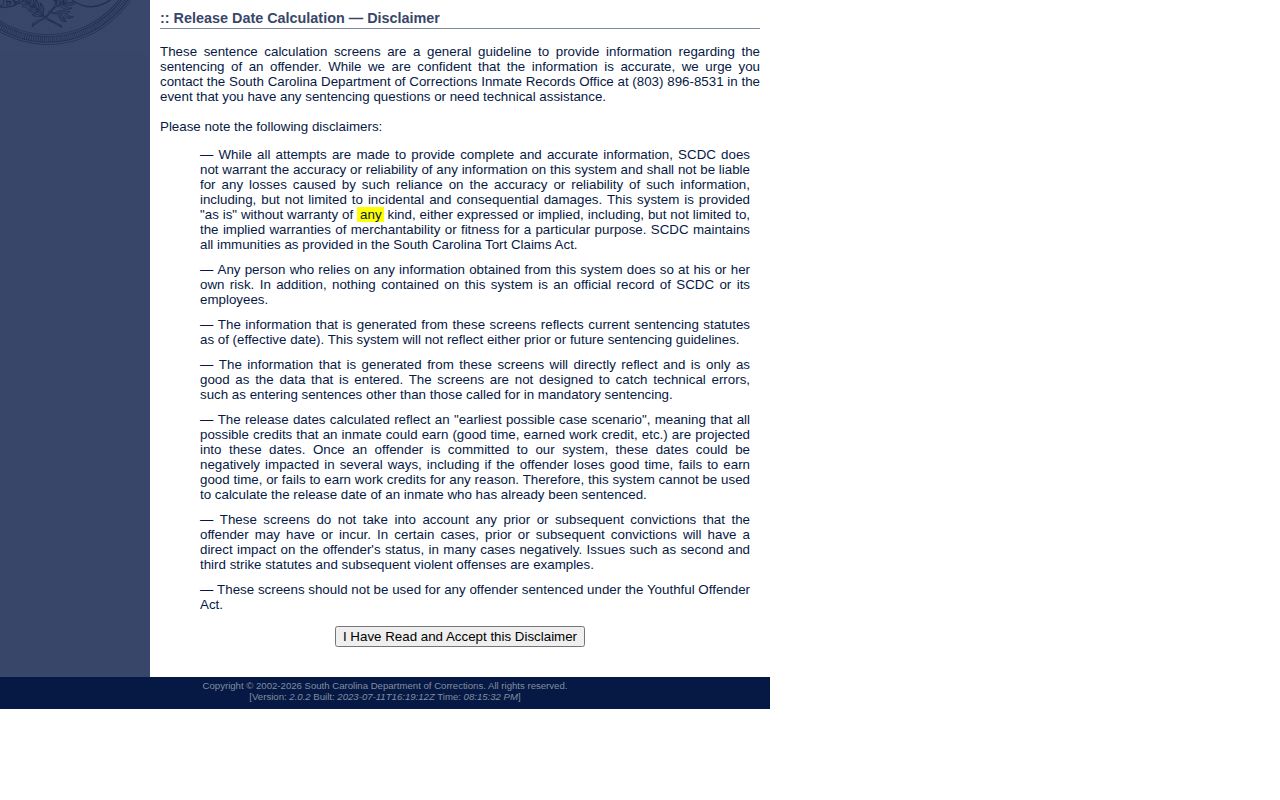
The tool depends on user inputs, does not account for all prior or later convictions, excludes Youthful Offender Act cases, and directs actual sentenced-person questions to Inmate Records.
Why Horry Release Dates Change
A sentence projection can move in either direction as its legal and administrative inputs develop. Some changes affect only the date. Others affect the destination at the end of custody. A new detainer, for example, may leave the institutional exit date intact while changing the event from community release to transfer.
| Factor | Possible effect | Source to confirm |
|---|---|---|
| Credit earned | May move an estimate earlier within statutory limits | JRLDC classification or SCDC Inmate Records |
| Credit forfeited or not earned | May move the projected date later | Custodian's sentence record |
| Later court judgment | May change the term or concurrent/consecutive structure | Signed court order and custodian |
| Detainer or hold | May alter the release destination or delay processing | Custodian and requesting authority |
| Parole action | May authorize, deny, modify, or revoke a conditional phase | Parole authority and SCDC |
| Administrative processing | Can make physical exit later than a court event | JRLDC or SCDC |
The SCDC current-inmate search is only for people presently incarcerated in SCDC. Research does not establish that every public current profile displays a projected date. Do not keep retrying that search for someone who has already left prison. Use the separate Released Inmate List for an event that has occurred.
A parole hearing date is not a projected exit. The Board can grant, deny, revoke, modify, or rehear matters under its authority, and a grant still requires processing and satisfaction of conditions. Ask SCDPPPS for an individual decision when needed, then confirm actual institutional release through SCDC. Administrative meeting minutes are not a substitute for a person-specific parole record.
Confirm Horry County Release Dates
For JRLDC, search the official Bookings & Releases application by Release Date or name and open the detail. Look for a dated “Released” label, and keep it distinct from “Out to Home Detention” or “Still Incarcerated.” The page's “Data last collected” timestamp is useful context, but the county publishes no guaranteed update cadence. Call JRLDC if an urgent status appears delayed.
For state prison, the SCDC Released Inmate List provides Release Date and Release Type. A COMMUNITY SUPV result means institutional custody ended while a community phase may continue. Follow it with the SCDPPPS supervision search. The released-list form and a Horry result are shown through the official state release search.
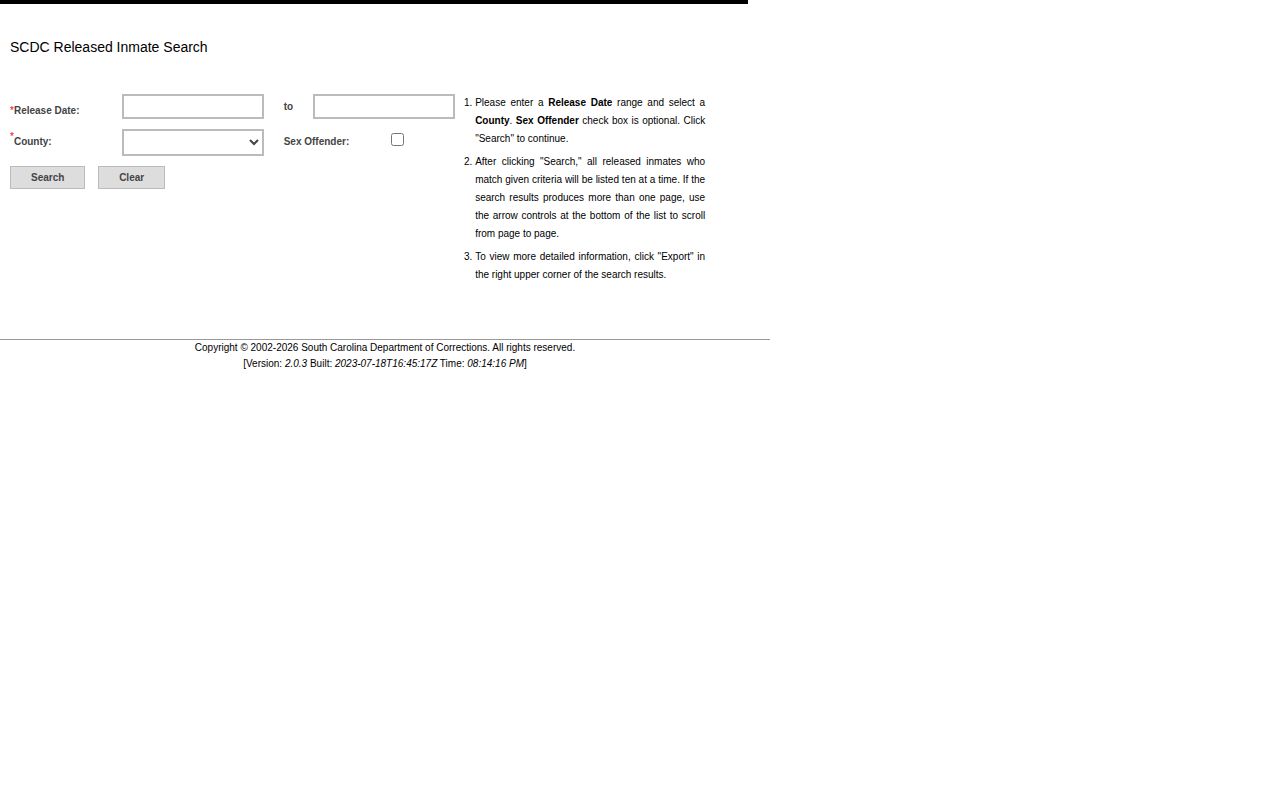
The date and type document SCDC's event. They do not by themselves show that every sentence or supervision duty ended.
South Carolina VINE can provide a pending release or transfer alert, but an alert should prompt confirmation with the custodian. Register again if the person moves from JRLDC to SCDC because the agency record changes. The VINELink release check explains the name search, notice methods, and telephone PIN.
If online data is missing, ask the custodian for the sentence calculation or dated release record. Use the person's full name, booking or SCDC number, approximate dates, and exact record sought. That focused request is more reliable than treating disappearance from a roster as proof.
Keep a simple verification record: the source searched, the identifiers used, the date and time checked, the status label, and the agency contact. If two dates differ, ask which one is the estimate, the court-authorized date, or the completed custody event. A newer result can properly replace an older projection after credits, orders, or holds change. Preserve the exact agency wording instead of translating it into “free,” “cleared,” or “finished the sentence,” since none of those broader claims follows from a release date alone.
Public Record Search
Sponsored Results