
Horry Parole and Probation Compared
Parole and probation both place a person under rules in the community, but they begin in different ways. The South Carolina Department of Probation, Parole and Pardon Services, known as SCDPPPS, supervises both. Parole is a conditional community phase after prison, authorized through the parole system. Probation is usually ordered by a court as part of a sentence and may occur without time in state prison. Neither term should be treated as a synonym for release from the J. Reuben Long Detention Center.
A county booking result proves a dated Horry County custody event. An SCDC release result proves an exit from state institutional custody. A current SCDPPPS result addresses supervision. The records can overlap, but one cannot replace another. The distinction is especially important when the SCDC release type reads COMMUNITY SUPV, which signals that institutional custody ended while a supervised part of the sentence may continue.
| Point | Parole | Probation |
|---|---|---|
| How it starts | Conditional release from prison through the parole process | Court-ordered community supervision, sometimes without prison |
| Main context record | SCDC release type, parole records, and SCDPPPS search | Sentencing order and SCDPPPS search |
| What release means | Prison custody ended, but supervision may remain | Jail release does not show whether probation began or ended |
| Best end-of-term proof | Agency discharge or completion record | Agency discharge or court completion record |
- Parole
- A conditional community phase following release from prison.
- Probation
- Community supervision ordered by a court as part of a sentence.
- Discharge
- The formal end of a correctional or supervision term.
- Absconder
- A person alleged to have stopped reporting or left supervision without permission.
Check Horry County Post-Release Supervision
The official SCDPPPS offender search accepts first name, last name, SID, county, and year of birth in the combinations stated on the form. SID is a state identification number and is the strongest way to separate people with similar names. The search warns that its information represents the previous day. A positive match can support a finding that supervision existed as of that date, but it does not establish the original jail or prison release time.
- Gather the full name, year of birth, and SID if available. Do not rely on a name alone when several records match.
- Run an allowed field combination in the SCDPPPS search. Open the matching person and record the page's data date.
- Check the county of supervision. It may differ from the county of arrest, conviction, release, or current residence.
- Use the SCDPPPS county-office directory for current-day confirmation in the county actually shown.
- If the issue is whether supervision ended, request a discharge or completion record. A missing search result is not proof of discharge.
The official interface and its previous-day warning can be reviewed through the SCDPPPS supervision search.
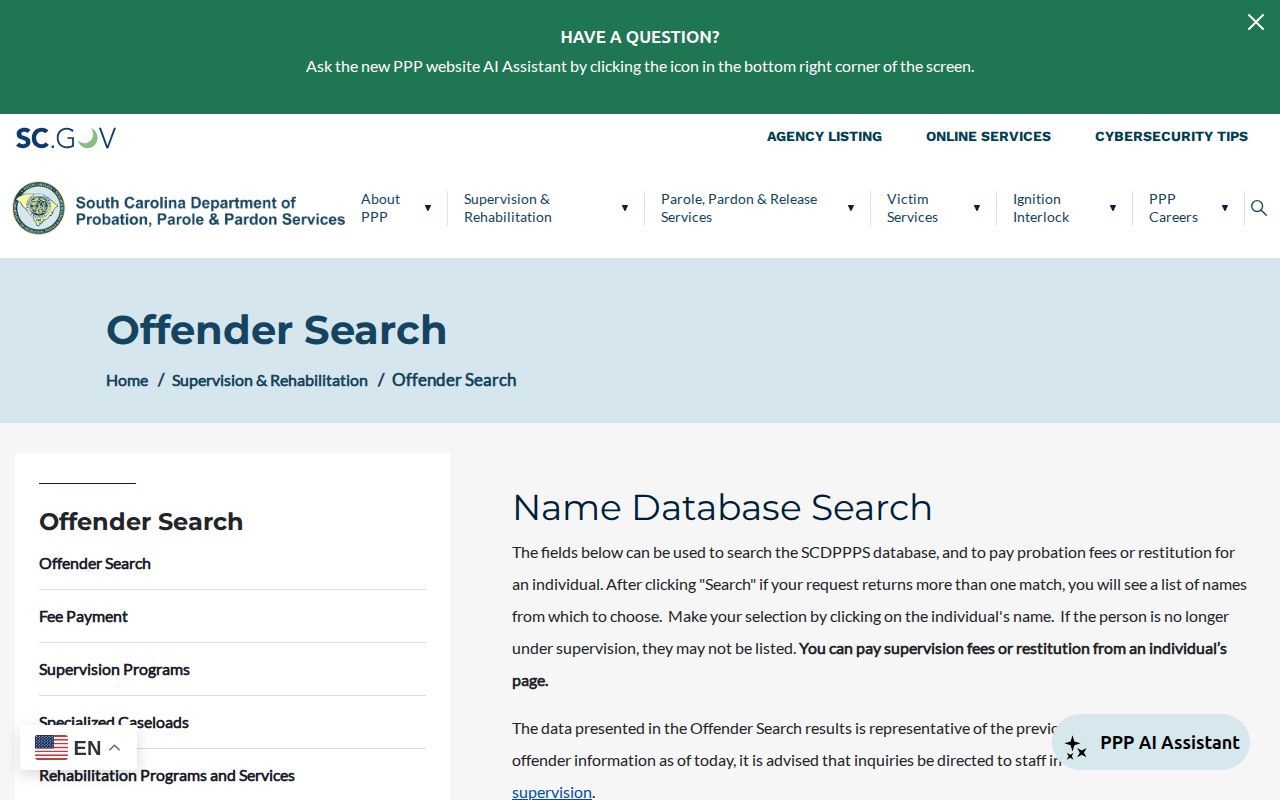
The form's field choices make careful identity matching more reliable than treating a name-only result as conclusive.
Use the source's date in any written note. “SCDPPPS listed the person under supervision as of the previous day” is more accurate than a broad claim about the present moment. If a result conflicts with a newer custody record, call the office rather than deciding that either system is wrong. A person can be arrested again, transferred, or moved to a different supervision county after the state data snapshot.
Horry County Supervision Office Route
SCDPPPS publishes a county directory rather than one permanent statewide assumption about where a person reports. Select Horry for the current listing, then confirm that the person is actually supervised there. The arrest county and supervision county do not have to match. Office assignments can also change during a term, so an old address or release paper should not override a newer agency listing.
The Horry selection in the county-office directory is shown below. It is the official route to the live local contact details.
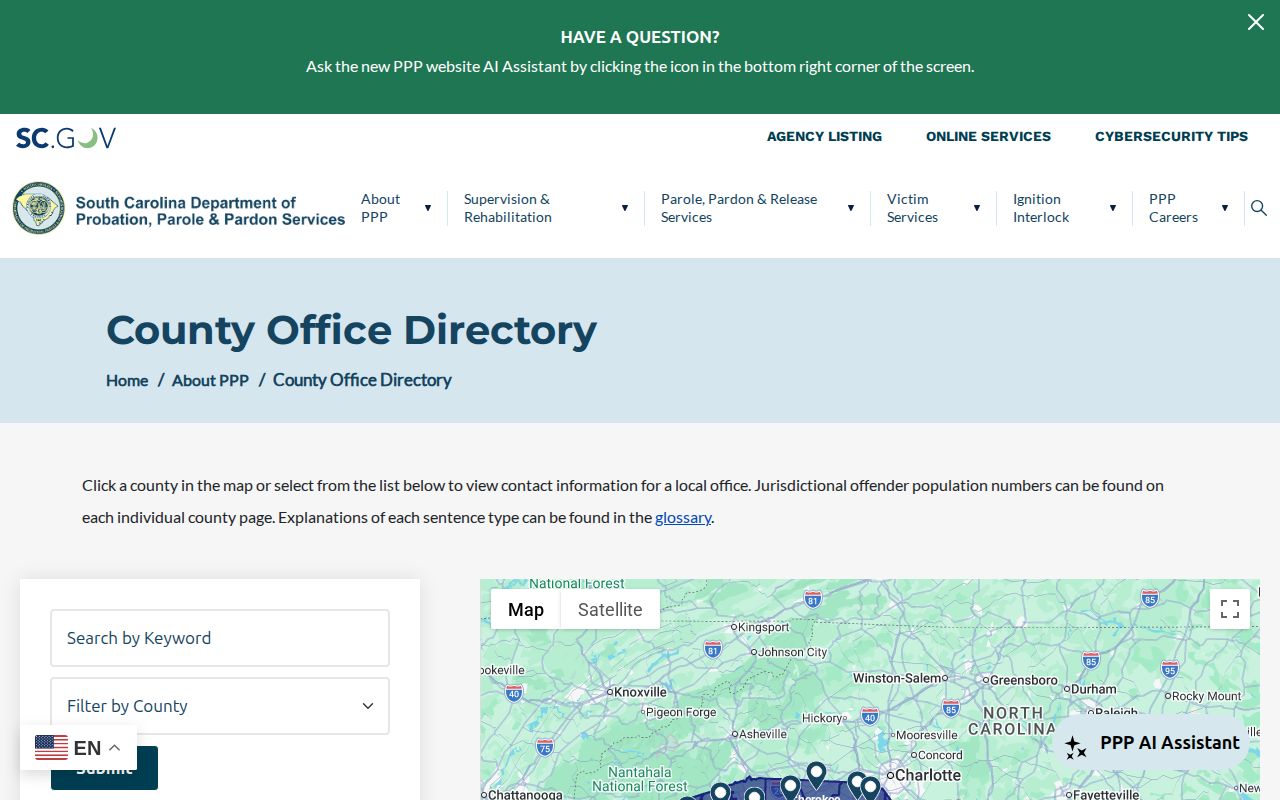
Use the directory entry for routine confirmation. The statewide agency can route a records request when the public result is not enough.
293 Greystone Blvd.
Columbia, SC 29210
paroleandpardonservices@ppp.sc.gov
County Office Directory
For a dated Horry County jail release rather than supervision, start with the Horry County released-inmate search and record path. The detention center record should not be used to infer the status of parole or probation.
Horry COMMUNITY SUPV Verification
South Carolina's state systems create a useful two-database check. The SCDC Released Inmate List reports the date and type of an institutional release. When its Release Type is COMMUNITY SUPV, check SCDPPPS next. A matching supervision record can corroborate that the person left prison but entered a continuing community phase.
This two-step method prevents a common error. “Released from prison” is narrower than “sentence fully discharged.” The first concerns the end of institutional custody. The second concerns the end of all correctional control, which may require a later discharge record. Conversely, a Horry County resident on probation may never have an SCDC release entry at all because probation can begin from court.
The state released list can also carry plainer values such as RELEASE or RELEASED. Report those terms as SCDC labels without supplying a reason the record does not state. Its county selector is not proof of where the person now lives or reports. Hidden export fields, including a detainer indicator, may add context but still do not replace the sentencing court or the supervision agency.
| Record | What it can confirm | What it cannot confirm alone |
|---|---|---|
| JRLDC Bookings & Releases | Exit from the county detention center | Current parole or probation |
| SCDC Released Inmate List | State-prison release date and type | That supervision has ended |
| SCDPPPS search | Listed supervision as of the prior-day data | Exact original release time |
| Court record | Probation order and case disposition | Physical release processing unless stated |
South Carolina VINE can add alerts for participating correctional systems, but it is a notification network rather than the formal discharge archive. Federal supervision also falls outside the state search.
Horry Supervision Warrants and Absconders
An absconder listing means the agency alleges that a person stopped reporting or otherwise left supervision without permission. It does not mean the person is back in prison, and it is not a complete history of all violations. SCDPPPS maintains a Most Wanted page and a statewide hotline at 1-888-761-6175 as a focused supplement. The agency warns that information changes and that listed suspects are presumed innocent.
Absence from the list proves little. A warrant may exist elsewhere, an entry may not yet appear, or the alleged violation may not qualify for that selected page. Do not approach a listed person. Immediate danger belongs with 911, while the official hotline is the proper route for information about the agency listing. Payment links on the supervision site also say nothing by themselves about compliance, debt, or current status.
A supervision violation can lead to review, a warrant, modification, or revocation. Revocation means the supervising authority withdraws the community status under the applicable process. The resulting custody event must then be checked with the agency that takes custody.
South Carolina VINE/SAVIN can send event notices from participating detention, corrections, and supervision systems. It is helpful when a new custody event follows an alleged violation, but the alert is secondary to the reporting agency. The statewide network is not a federal locator, and a registration may need to be renewed after an agency transfer.
Horry Parole and Probation Discharge
Conditions vary with the court order, parole action, and individual supervision plan. At a high level, they can include reporting, location or travel limits, program duties, and compliance with orders. A public search is not the full supervision file. It should not be used to guess at a person's individual terms or whether an unlisted act is a violation.
When supervision ends, seek the record that says so. SCDPPPS can supply or route a request for a releasable discharge or completion record. A probation matter may also have a court entry. South Carolina FOIA generally provides access to nonexempt public records, but privacy, safety, investigative, sealed, and expunged material can be withheld under law. A request should name the person, SID if known, date range, type of supervision, and the exact discharge or completion record sought.
Parole-board hearing material answers a separate question. The Board of Paroles and Pardons handles grants, denials, revocations, modifications, rehearings, and other authorized actions. Its calendar is not proof of release, and the administrative meeting-minutes archive is not a name-searchable decisions database. A hearing date can precede any actual prison exit.
If a parole outcome is not publicly retrievable by name, request the individual releasable decision through SCDPPPS at paroleandpardonservices@ppp.sc.gov. State law gives the Board defined review duties and voting rules, but eligibility does not guarantee a grant. Good-behavior credit also does not automatically move a parole eligibility date. Those are different calculations governed by different parts of South Carolina law.
Keep the scope exact: the jail documents county custody, SCDC documents prison custody, SCDPPPS documents supervision, and the court documents its orders. Together, those sources can establish a sequence without overstating any one record.
Public Record Search
Sponsored Results